
Foot and Ankle Conditions

Achilles Tendinopathy
Achilles tendinopathy is a common cause of pain at the back of the ankle or heel. It can cause pain, stiffness and tenderness in the Achilles tendon, particularly when walking, running, climbing stairs or pushing up onto your toes.
Achilles tendinopathy can develop gradually or follow a change in activity, training or footwear. The way your foot and lower limb move can also influence how load is transferred through the Achilles tendon. Read More

Baxter's Nerve Entrapment
This is a fairly common cause of pain on the underside of the heel and accounts for up to 20% of all plantar heel pain. Many symptoms of this condition are similar to plantar fasciitis, and because of this sometimes the correct diagnosis is missed.
Unlike plantar fasciitis, with this condition there is not usually any pain when getting out of bed in the morning. See More

Calluses and Corns
Calluses and corns are areas of thickened, hardened skin that develop in response to repeated pressure or friction.
They are particularly common on the feet, where pressure can be concentrated beneath the heel, ball of the foot, toes or other areas that come into contact with footwear or the ground.
Although corns and calluses are made from thickened skin, they can sometimes indicate that a particular area of the foot is repeatedly being exposed to increased pressure.

Ankle Sprain
A common injury caused by a twisting over on the ankle (the ankle usually rolls outward as the foot turns inward) resulting in overstretching or tear in one of more ankle ligaments.
An ankle sprain usually causes immediate pain, swelling, bruising and tenderness near the site or the ligament, and ranges from mild to severe. See More

Bunions
A deformity of the big toe joint in which the joint becomes enlarged, stiff and often painful. The area can become red as shoes rub over the enlarged area.
The big toe often moves towards the 2nd toe and in the medical profession is known as Hallux Valgus. See More

Flat Feet
Flat feet are common and don't necessarily need treatment. The important question is whether your foot posture and movement are contributing to pain or affecting how you function.
Flat feet, fallen arches, low arches, pes planus and hindfoot valgus are terms used to describe different aspects of a foot with a lower medial arch and, in some cases, a heel that tilts towards the midline.

Hallux Limitus or Rigidus
Hallux rigidus and hallux limitus describe problems involving movement of the big toe joint, also known as the first metatarsophalangeal joint.
The big toe needs to move as you walk, particularly as your body moves forwards and you push off the ground. If movement at this joint becomes restricted or painful, it can affect the way you walk and may cause pain around the big toe and forefoot.
Hallux rigidus is commonly associated with arthritis and degenerative changes in the big toe joint. Hallux limitus is generally used to describe restricted movement of the joint, although the terms can overlap and the distinction is not always straightforward.

Morton's Neuroma and Forefoot pain
Morton’s neuroma is a common cause of pain in the ball of the foot. It can cause burning, shooting or sharp pain, tingling or numbness into the toes, and sometimes the sensation that there is a pebble or lump inside your shoe.
Although it is commonly called a “neuroma”, Morton’s neuroma is not a nerve tumour. It involves irritation and thickening of tissue around one of the nerves that runs between the metatarsal bones of the forefoot. Read More

Metatarsalgia
Metatarsalgia is not a diagnosis as such but a term which describes pain in the forefoot in the region of the metatarsal bones. It is important to see a foot specialist who can assess this condition in more detail to get the proper diagnosis and treatment.
There are several causes of Metatarsalgia: Mortons Neuroma, Capsulitis, Plantar Plate Tear, Freiburgs Infarction, Fracture, Calluses and Corns.
Plantar fasciitis & plantar heel pain
Heel pain can be frustrating and limiting, particularly when it affects walking, running, work or everyday activities.
Plantar fasciitis is one of the most common causes of pain underneath the heel. It typically causes pain around the centre or inner part of the heel on the underside of the foot, which can sometimes extend towards the arch.

Tarsal Tunnel Syndrome
This is a less common condition that is characterised by electric shock or shooting pain, tingling, burning and numbness underneath the heel and the sole of the foot
It is caused by excessive compression of the Tibial Nerve as it passes through the Tarsal Tunnel which is a sheath of connective tissue that runs across the inner aspect of the heel. See More
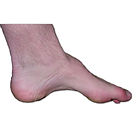
High Arched Feet
High arched feet, Pes Cavus or Supinated and Varus feet are all terms that describe feet with an increased arch height and an outward heel tilt (away from the midline).
High arched feet are much less common than Flat Feet and are generally described by their function as either rigid or flexible.